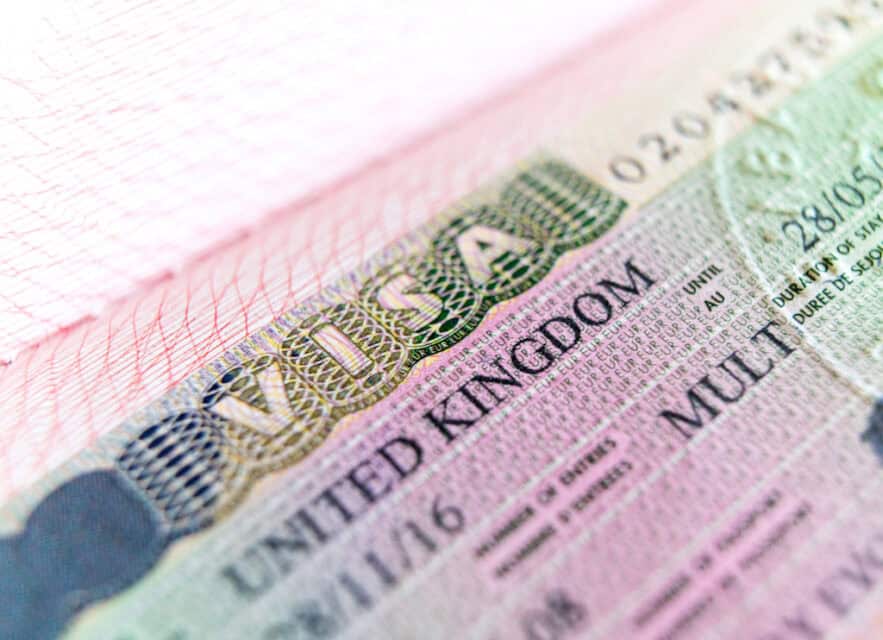
In a move designed to clamp down on so-called “abuse” of the asylum system, the UK’s Home Office announced an emergency brake for student visas to main applicants from Afghanistan, Cameroon, Myanmar and Sudan.
The policy received widespread condemnation from international education stakeholders as students who had managed to bag themselves coveted Chevening scholarships from the affected countries found they could no longer come and study in the UK.
There was also confusion over the decision to apply a visa break on nationals from these countries, given how relatively few applications there were from each nation. According to Home Office data, in 2025, before the brake, those four countries received 3,126 student visas between them, under 1% of the total.
Crunching the numbers, it becomes apparent that the countries that send the most students to the UK who then go on to claim asylum are Pakistan, India, Bangladesh, Nigeria and Sri Lanka. However, none of them is subject to a brake. A High Court judgment from August shows why.
In October 2025, officials found that Bangladesh had met the threshold for the brake. The Home Secretary agreed to defer it, because “the UK has deeper bilateral equities with Bangladesh” and action would “jeopardise other priorities such as maintaining and enhancing our returns cooperation”. A visa brake for Pakistan, officials wrote, was “harder to make a case for, but not impossible”.
How the test works
The Home Office picked the four countries it eventually braked with a simple ratio. It counted asylum claims from people whose last visa was a student one and divided them by the student visas issued to that nationality in the same year. A country was flagged if the result was 15% or more and there were at least 100 claims.
In effect, the ratio catches out small countries and spares large ones. In the year to September 2025, the on which year the test was run, Afghanistan was flagged with 470 claims against 360 visas.
Pakistan had more than 10 times as many claims, but against about 39,000 visas: on the published data its ratio was 13.9%, and the Home Office’s own count, cited by the House of Commons Library, put it at 14%.
India’s asylum claims are a tiny share of a very large number of visas. The judge accepted the method as “within the range of reasonable methodologies”, and the claimants’ appeal is pending.
The chart below shows the test run on the latest published data, for the year to June 2026.

The braked countries sit to the right of the 15% line as small bubbles. Pakistan and Sri Lanka sit just short of it, and Pakistan is the largest bubble on the chart, with Bangladesh behind them. Iran surpassed the threshold, was on the list the Home Secretary agreed in January 2026 and was – inexplicably – later dropped.
The pressure moves to universities
The looming threat of a visa brake is not the only tool keeping a lid on the number of international students from certain countries.
As part of new, tighter Basic Compliance Assessment thresholds, UK universities must keep their visa refusal rate under 5%, down from 10%. As visa refusals soar, that limit is hardest to meet in the markets the brake left alone: in the year to June 2026, 18.3% of Pakistani student visa applications were refused, and 14.0% of Bangladeshi ones.
Universities have responded as the Home Office expected. London Metropolitan University stopped recruiting in Bangladesh in July 2025. The University of Derby paused Pakistan and Bangladesh the following March, citing refusal rates “far above the new threshold”.
In the markets the Home Office chose not to brake, universities are being judged on a problem their own figures do not record
The brake’s impact assessment lists this among its benefits: sponsors “may pivot to other student and labour markets or adapt their application process to select those most likely to complete the period and terms of their visa”.
Another way international students from ‘risky’ markets are being affected is being persuaded to withdraw applications before the Home Office can refuse them.
As we showed in The PIE News, 11,500 student visa applications were withdrawn in the year to June 2026 – double the year before. Count those alongside refusals and the sector’s overall rolling visa refusal rate is 7.5%, not 4.9%., as has already been reported
A second phase is already on paper
The High Court judgment makes clear that the four countries already subject to a visa brake were a first step of a larger asylum clampdown.
Bangladesh was deferred “to stage two of this process”. Officials considered a second trigger of 500 or more claims a year, which would catch Pakistan, Bangladesh, India, Nigeria and Sri Lanka among others, but decided to hold it back for “later phases”.
The government also looked at targeting individual programs rather than whole nationalities, but rejected this idea for now. After all, there are no standard course codes, course names vary between universities, and applicants could switch courses to get round this rule.
No date is given for a second phase. The brake itself runs for “an initial 18-month period”, so the review of the first four countries falls in September 2027.
Before that, the Home Office data release next month will show where Pakistan, Bangladesh and Sri Lanka stand against the 15% line for the year to September 2026.
The Graduate Route
The brake’s test counts only people whose last visa was a student visa, but leaves out graduate visa holders, who finished a UK course and were given a second visa to stay and work.
In the year to June 2026, asylum claims from former student visa holders fell by 35%, to 9,442. However, claims from graduate visa holders more than doubled, to 5,130.
The Home Office treats these two different routes as the same problem. When Myanmar’s work visas were flagged, mostly because of graduate claims, the Home Secretary decided the student brake alone would do, because in the longer term it “would prevent asylum claims from the Graduate Route”.
This is the part universities cannot see. The BCA measures refusals, enrolment and course completions. It does not count asylum claims.
A student who enrols, completes, moves on to a graduate visa and then claims asylum has passed all three. In the markets the Home Office chose not to brake, universities are being judged on a problem their own figures do not record.
Add graduate claims to the test and the picture changes. Pakistan would be at 21.0% and Bangladesh at 20.6%, well over the line. That is not the test the Home Office uses, and these students’ visas were issued in earlier years, but it shows how thin the margin is.

Do refusals follow asylum claims?
Only partly. The student visa refusal rate rose from 3.1% in the year to September 2025 to 4.9% in the year to June 2026. Most of that rise came from two countries, Nigeria and Pakistan. Pakistan fits the asylum story. Nigeria does not: its claims are only 2.4% of its student visas, yet its refusal rate rose from 4.5% to 11.6% over the same period.
The claims universities can act on are also falling. Measured against student visas issued a year earlier, claims from former student visa holders fell from 2.5% in the year to June 2024 to 2.2% in the year to June 2026. Add the Graduate Route and the same measure rose from 2.6% to 3.4%. The growth is among people who had already finished their course.
The student’s choice
Much of the debate treats asylum claimants as one group – but the ultimate asylum decisions tell a very different story.
In the year to June 2026, 92% of Sudanese asylum claims decided were granted, and 86% of claims from Myanmar nationals. For Bangladesh the figure was under 10%.
The Home Office’s own definition of misuse, recorded in the judgment, covers people who applied for a visa intending to claim asylum, or who claimed when nothing relevant had changed at home since they arrived. A claim made because things did change in their home country is not misuse.
A Sudanese student who started a one-year master’s in September 2022 was halfway through when fighting broke out in Khartoum in April 2023. An Afghan woman with a UK offer comes from a country where women are barred from university.
Neither reason is considered misuse on the Home Office’s own terms. Meanwhile, for Afghanistan, where claims outnumbered visas in 2023, 2024 and 2025, the judge found the figures showed “the likelihood that claims were being made in circumstances where conditions had not materially changed since the visas were granted”.
The cost falls on people the brake was not aimed at. The government’s own impact assessment puts the loss to universities at about £84 million in fees, and estimates that of the 4,300 students it keeps out, about 1,300 would have claimed asylum. The other 3,000 would not.